I am diverting from my day-by-day musings to answer many of your questions about the most charismatic creature on earth, the beloved and engaging penguin. I’ll start by answering many of the questions you have already asked or may be thinking about.
HERE’S WHAT I LEARNED FROM THE PEOPLE WHO KNOW ABOUT PENGUINS
Penguins are only found south of the equator in both warm and cold climates. There are 17 species of penguins, which is an amazingly small number since there are 10,000 species of birds. Four species live on the Antarctic continent: the Adelie, the Emperor, the Chinstrap and the Gentoo. Three species live on sub-Antarctic islands: the King, the Macaroni and the Rockhopper. We have seen five of the species to date and expect to see a sixth on the Falkland Islands. The Emperor penguin is a rare sight and we would be thrilled to discover one.
Early Antarctic explorers actually thought penguins were fish and classified them accordingly. In fact, as birds, they are superbly designed for their job, flying underwater with great skill. Their compact bodies have a breastbone that makes an excellent keel, their elbow and wrists are fused creating a flipper for propulsion and their feet act as a rudder. Penguins can stay under water for 25 minutes, dive as deep as 1,000 feet and propel to speeds up to 25 miles per hour.
Above water, penguins are flightless birds. Some species spend as much as 75% of their lives at sea, but they all breed on land or sea-ice attached to land. To withstand the harsh conditions of the Antarctic, their bodies are insulated by a thick layer of blubber and a dense network of waterproof plumage with a layer of soft down feathers underneath.
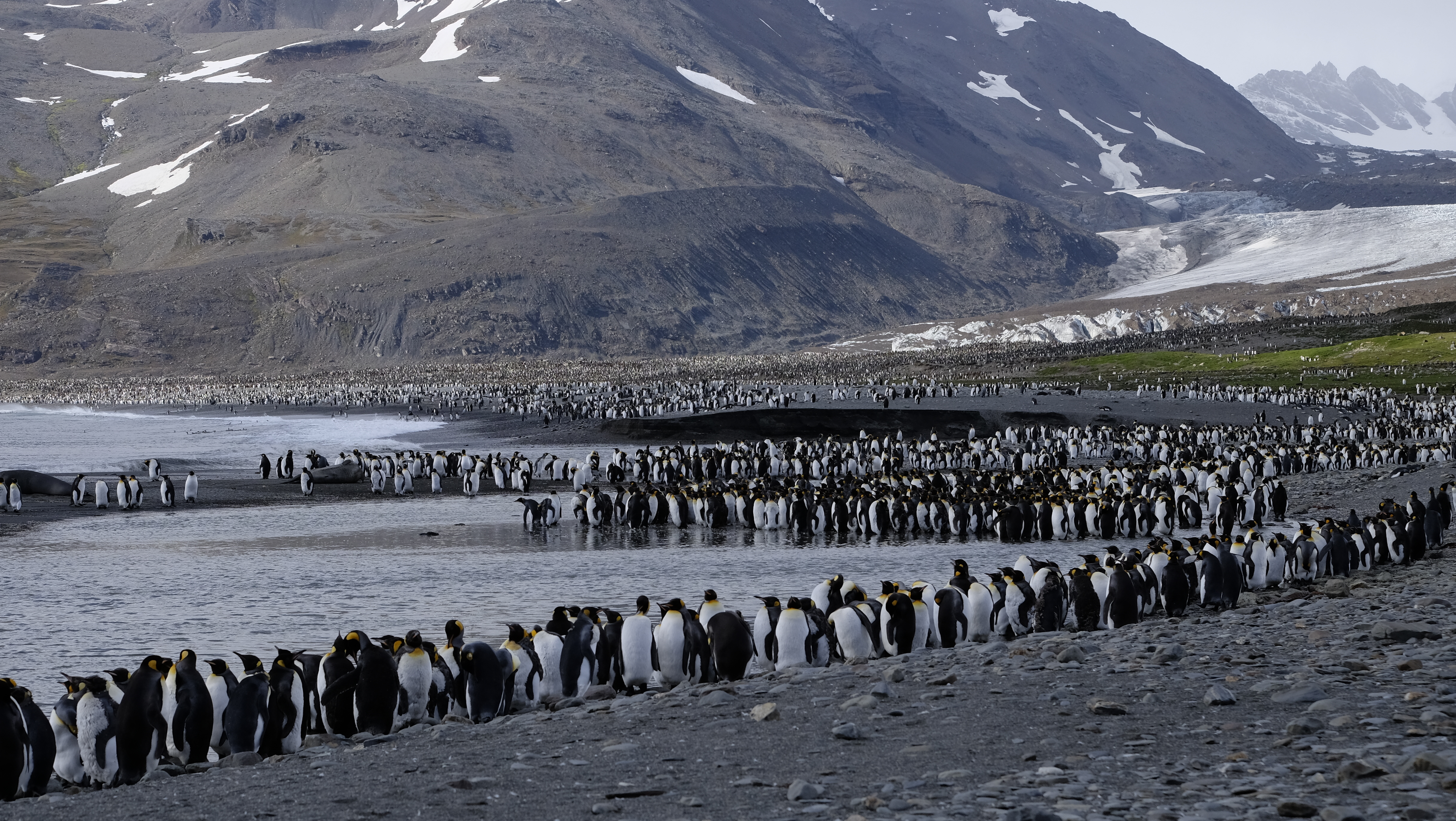
Penguins generally breed in large, dense colonies called rookeries. Rookeries may be a handful of breeding pairs or up to half a million birds and more. Some species build nests that are a simple pile of stones that are continually stolen and swapped between members of a colony when the owners are not looking. The nests are slightly higher than the surrounding land so if the temperature rises and the snow melts, the nest is not flooded.
Most species lay two eggs, though it is rare that two chicks are raised. If food is in low supply it will be fed to the biggest and strongest only. Male and female parents share egg and chick duty while the other one looks for food. Chicks are fed regurgitated fish and krill. The chicks leave the nest, or parents’ feet, when they are large enough to keep their own temperature constants. They form crèches to give each other mutual support and protection from predators and protection against the cold and wind.
Natural enemies of the penguin include leopard seals, killer whales and, in the case of young chicks and eggs, several species of seabirds. Healthy adult penguins have no predators on land so they have no natural fear of humans. Instead, they are quite curious about the people they see, a big part of their charm.
A penguin walks with a rather comical motion, swaying from side to side with each step like a drunken sailor or toddler just learning to walk. This is a consequence of being a tall top-heavy animal with short legs. They can move quicker and more efficiently by laying on their bellies and sliding down slippery ice or a snowy slope. Using their strong toes to push themselves, they can actually outpace a running human using this style.
Penguins feed on krill and fish, depending on the species. The species diet is easy to tell. Krill-eating penguins excrete pink quano (poo) with an aroma that can be quite overwhelming while fish-eating ones excrete white quano, which leaves very little aroma in the air.
Next, I will tell you what I have learned from the penguins.
Bon Mot for today: “The deserted rookery was sure at all times to be above high watermark, and we mounted the rocky ledge to search for a place on which to pitch our tents. The disadvantages of a camp on the rookery were obvious – the smell, to put it mildly was strong; but our choice of site was small…” – Sir Ernest Shackleton (speaking of Point Wild on Elephant Island)

Leave a Reply